Showing posts with label watchmaking. Show all posts

Saturday, January 28, 2012

The Going Train - A Melodrama in Three Parts

When we last looked in, the energy in our mechanical watch or clock had entered the device by means of a purposeful winding or by taking advantage of the potential energy in a raised weight as it descended to the earth. The energy was then stored in a tightly wound mainspring (in the case of the watch), wound around an arbor and connected to a barrel, which was both free to spin and capped with gear teeth. The barrel, which comprises all of those elements - the mainspring, arbor, and the gear-capped cylinder - interlocks with the all-important going train, which is the subject of this week's adventures in horology.

The Cast of Characters:

- The Mainspring Barrel  - a strong, steady type, as we saw in last week's episode. Strives to keep things moving smoothly, but can be a bit pushy.

File:Dscf3997 FederhausKleinuhr.jpg
The mainspring barrel, with and without the mainspring. Photo from Wikimedia Commons, but lacking a source. If this is your photo, please contact me and I will credit you!
- The Center Wheel - a newcomer to the story. In lockstep with the Mainspring Barrel, it keeps a very regular schedule. The Center Wheel has the honor of holding the Minute Hand, which gets paraded around once an hour like clockwork. Also charged with driving the Third Wheel.


- The Third Wheel - an awkward but necessary character. Is only included in the train to make the math work, and he knows it. Takes his duty of driving the Fourth Wheel very seriously, however.


-  The Fourth Wheel  - The Fourth Wheel has the dubious distinction of carrying the second hand - dubious because of the diminishing number of clocks that choose to flaunt a second hand. Worries that he will soon be obsolete. Also troubling: his second function of driving the escape wheel could easily be taken over by the Third Wheel, who has upward aspirations.

He's very shy.

- The Escape Wheel  - a spiky fellow, but absolutely necessary member of the Train. Has an impeccable sense of time and knows just when to give the Balance Wheel a push to keep it in the game. Very tight with the Escapement - they have a whole system worked out to make sure things happen on time.
Courtesy of mfrasca at en.wikipedia.
- The Pinions  - Small but mighty gears, without them the math simply would not work out. They feel strong attachments to their respective main gears and ensure that communication between all the biggest players comes off without a hitch.

In a watch, the pinion is on the outside. But you get the idea - it's a smaller gear rotating with the main gear to dial up or dial down the speed of rotation.


The Plot:

The reckless and headstrong Mainspring is hell-bent on pouring all of its power into the timepiece at once. There is much consternation and frenzy - too much energy in the watch at once will destroy the lovely Hairspring and rip apart her equally entrancing sister, the Balance - and without the Balance, there can be no Time! When it appears that no solution is forthcoming, at the last minute the valiant Gear Train leaps into action.

The Action:


The spring is wound and the stage is set. The mainspring pushes inexorably on the Mainspring Barrel, which grabs hold of the Center Wheel's pinion and forces it into lockstep. The dutiful pinion transmits the force of the Mainspring Barrel to the Center Wheel.

Due to the loyal pinion, the Center Wheel does not turn with nearly the force of the Mainspring Barrel, and lets the world know of its success by spinning the minute hand around the clock face at the rate of exactly one time per hour. The Center Wheel captures the attention of the Third Wheel's pinion, which spins the Third Wheel and distributes the Mainspring Barrel's energy even further. Already things are looking up for our heroines, the Hairspring and the Balance.

The Third Wheel spins the Fourth Wheel's pinion, raising the rate of rotation in its excitement. The Fourth wheel spins frenetically around at one turn per minute. In the midst of this frantic rotation, the Fourth Wheel finds the time to drive the escape wheel - the last gear to stand between the Mainspring Barrel and the Balance.

The Escape Wheel looks odd - its teeth are spiky, and it's made of different stuff than a proper watch gear. But the Escape Wheel is a steady fellow. He knows that without him, the rest of the watch gears would rotate with abandon, expending the Mainspring Barrel's energy with no regard for Time at all. The Escape Wheel is a regulator - he rotates precisely one tooth at a time in an arrangement he's worked out with his friend the Anchor. The Anchor is precisely that - it keeps even the Escape Wheel in check. Once the Escape Wheel has been brought down to a steady tick-tock rhythm, it sends just a bit of its energy down do the Balance - just enough to keep her spinning, rather than destroying her and the Hairspring in the process.


The Denouement: 
Thanks to these brave gears, the force of the Mainspring Barrel has been dialed down to a manageable force, and is even useful in keeping the Balance - she who actually keeps the time - running. Along the way, we passed over the contributions of the Motion Work and the underlying input from Gear Ratios.

All topics for the future.


Until next time!

Tuesday, January 24, 2012

Time and a Half


 I've never been one for small aspirations. As a kid, if they told me to build a model building out of paper, I was
 going to use the longest, thinnest paper available and hold the thing together by sheer force of will. After college, I
 wanted to work in science museum, so I picked the best one I knew of, got an (unpaid) internship, and flew
 across the country to start working two months later. When I decided to learn to snowboard, I took the ski lift to
 the top of the bunny slope, strapped in, eavesdropped on a kids' lesson to learn how to stand up, and went off to
 go snowboarding.

 I mention this because I know my own tendencies, and I suspect that my next project is beyond the scope of
 anything else I've tackled so far. I want to make a wooden clock.

 I chose a gear for my first SketchUp tutorial for a reason. I have a major soft spot for anything clockwork
 (from *before* it was popular, thankyouverymuch) and a serious penchant for little
 fiddly projects. I think precision makes things beautiful, and if you've ever seen the inside of a mechanical
 watch, you'll know that it's been precision-ed to death. So, a clock it is. Wooden because metalwork is a little
 beyond me right now and besides, look at this thing. It's gorgeous. This particular one is done by an immensely talented woodworker named Wayne Sutter.
This is gorgeous, and it's not even finished in this shot. Go buy a clock from him - we need more craftspeople like this.

 Clocks, especially mechanical ones, are amazing and complex works of careful engineering. Sounds like a
 great amateur project, doesn't it?

Image from Wikimedia Commons. Yay public domain!


 Clocks from the inside out
 Initial impression: Holy crap, there's a lot of vocab here. Right off, we have: mainspring, arbor, going
 barrel, ratchet, pawl, pinion, wheel train, escapement, remontoire, and balance wheel, just to name a few.

From a mechanical perspective, I think that the easiest way to tackle a watch movement (the whole thing in the back of a clock or watch that makes the thing go) is to trace the energy. Energy goes into the watch when you wind it, and out of it as the stored energy is expended in making the hands turn and the escapement oscillate (and the alarm go, and the cuckoo bird cuckoo, etc.). When you wind a watch, you spin a post, or turn a key that turns a post, called an arbor. The arbor connects to a spiraling strip of metal called the mainspring.
The mainspring.
Image from Wikimedia Commons.

 The mainspring is attached to the arbor from the inside of the spiral, making the whole thing look a little like a spinning top, or maybe a barred galaxy if you're creative. 

The arbor/spindle/massive beams of radiation would be coming out of the center of that.


The other end end of the mainspring attaches to a short, fat cylinder called the going barrel.

Also Wikimedia.
The barrel is free to spin, which is a good thing, because the barrel cylinder is capped with what is essentially a solid gear. This gear is used to interact with the gear train, which is the bit that makes the hands and other useful parts move. Its most important function, though is to power the balance, the little wheel that does for a wristwatch what a pendulum does for a grandfather clock.  

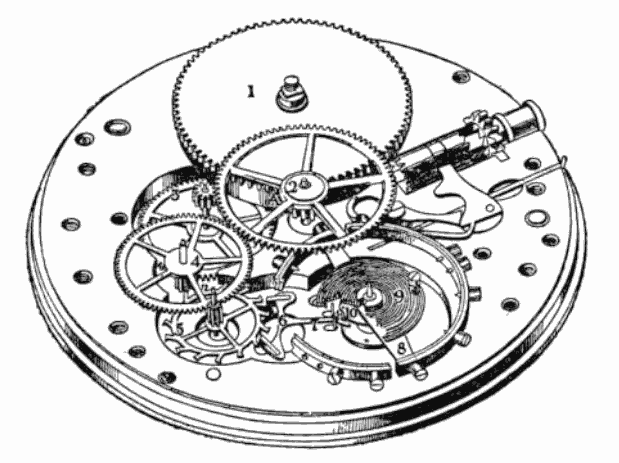
A real-life example: the going barrel in this watch is capped by the gear you can see in this picture. It also happens to be upside down.

Suppose you got bored at this point and thought, what the hell, we've got a power source and something that spins - let's just put some hands on it and let 'er rip! You'd have a timekeeping device of some sort, but right now there's nothing to counteract the force of that spring - you'd wind it, let it go, and it would release all its energy all at once. You'd measure time in spring-unwindings instead of seconds. 

That's where rest of the gear train comes in. That'll have to wait for part two, though. In the meantime, here's some watch porn for all you horologists out there. 

...that even sounds dirty.